Bedding & Sleep Guide
Choosing an Organic Crib Mattress: Fit, Materials, and Care
A crib mattress is an unshowy object with an unusually important job. To compare organic options thoughtfully, begin with the fit, the firmness, and the instructions for everyday care—not with a broad promise printed on a label.
A practical guide for caregivers assessing an infant sleep surface.
Shopping for a crib mattress can feel like entering a small, specialized world of fiber names, seals, layers, and reassuring adjectives. Organic cotton, natural wool, breathable cover, chemical-conscious construction: each phrase points toward a question worth asking, but none answers the question that comes first. Does the mattress fit the crib as intended, and does it provide a firm, flat surface for the baby’s sleep?
That order matters. A crib mattress is not simply a miniature version of an adult bed. Its dimensions, firmness, construction, and permitted accessories must work with the specific crib and the applicable safety guidance. Materials are part of the decision, too, but organic labeling does not replace checking safety information, fit, or use instructions. A careful choice is less about discovering a perfect material and more about understanding what each claim means—and what it does not.
This guide offers a neutral way to compare organic crib mattresses. It covers fit, sleep-surface firmness, construction, certifications, care, and questions to ask before bringing a mattress home. It is general consumer information, not a substitute for current guidance from health or product-safety authorities, or for the instructions supplied with a crib and mattress.
Start with the crib, not the label
“Standard-size crib mattress” sounds like a precise specification, but the phrase should never be treated as a guarantee of compatibility. Check the crib’s manual for the mattress size and type it permits, then compare those directions with the mattress manufacturer’s stated dimensions. Nominal size descriptions can conceal small differences, and a mattress must fit the crib it will actually be used in—not merely a crib of the same general category.
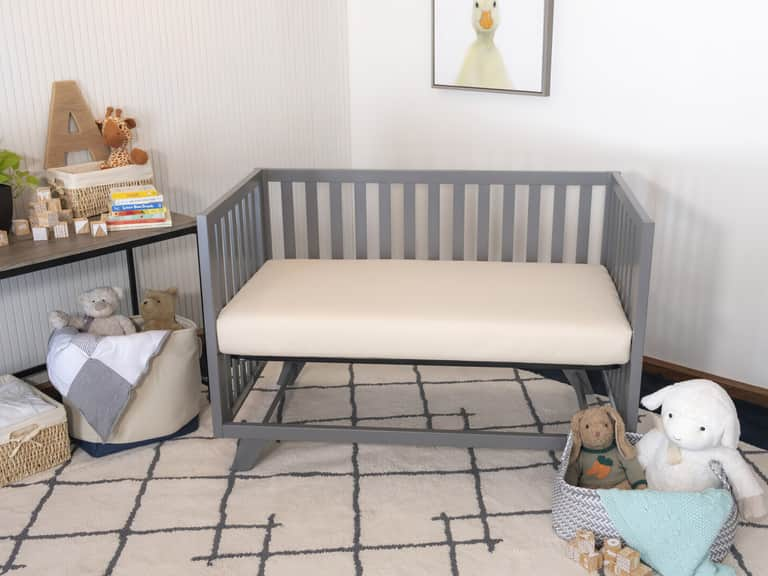
With the mattress placed in the crib according to the instructions, inspect the perimeter. It should sit level and snugly, with no obvious gap between the mattress and the crib sides. Caregivers should use the crib and mattress manufacturers’ guidance for assessing fit; a generic rule of thumb is not a substitute for those directions. If the fit appears loose, uneven, or otherwise uncertain, do not improvise with extra padding or a different mattress. Contact the manufacturer or retailer for clarification before use.
Fit is also affected by the crib’s design and assembly. Confirm that the crib is assembled correctly, that its mattress support is set at the appropriate height, and that all components are in good condition. If the crib has been handed down, check its model information and current safety status rather than assuming that age or familiarity proves it remains suitable. The mattress and crib are a system; evaluating one without the other leaves a significant part of the question unanswered.
Before purchasing, record the crib’s required mattress dimensions, the mattress’s listed dimensions, and any limitations on thickness or construction. Keep the manual available when the mattress arrives. This is a modest bit of preparation, but it can prevent the very common confusion of discovering that a product described as “crib size” does not fit a particular crib as expected.
Firmness and a flat surface come first
For an infant, the relevant sleep surface is firm and flat, used in accordance with current safe-sleep guidance. “Firm” can be difficult to judge through photographs or marketing language. A mattress that feels comfortable to an adult, or seems plush when pressed in a showroom, is not necessarily appropriate for an infant. Avoid selecting a crib mattress by applying adult preferences for softness, contouring, or pressure relief.
Read the product’s intended-use statement carefully. Some mattresses have two stages or two sides: one side is designated for infant use and another for an older child. If a mattress has this arrangement, follow the manufacturer’s age and use directions precisely. Do not infer that a softer side is suitable simply because it is included, or switch sides based on a child’s apparent comfort. A label describing a toddler side is not a reason to use that side for an infant.
Likewise, “breathable” is a construction description, not a reason to disregard safe-sleep recommendations. A breathable cover or removable pad may be part of a product’s design, but caregivers should understand exactly which components are required, optional, or approved for use. Follow the mattress and crib instructions, together with current guidance from appropriate public-health and product-safety authorities. No material feature should be treated as a substitute for a safe sleep setup.
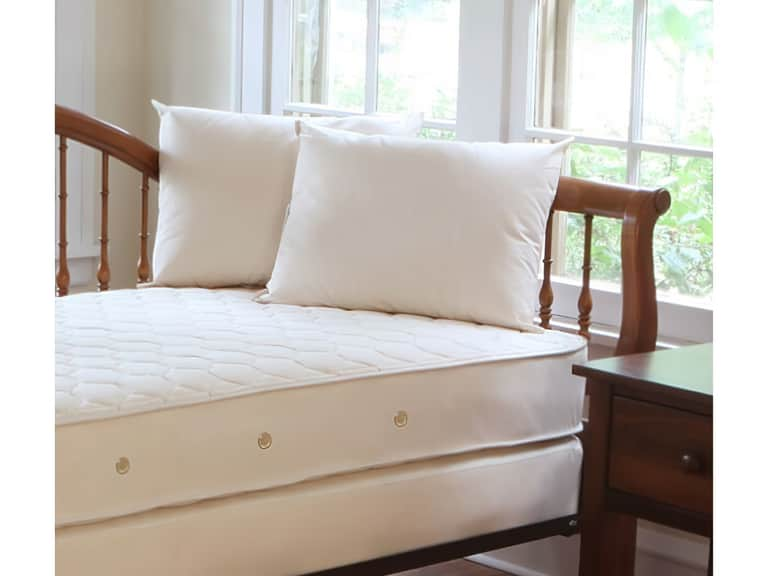
One available example is the Naturepedic Breathable 2-Stage Organic Crib Mattress. Its product description identifies a firm, flat mattress, two designated sides, and a removable, washable pad. Those details illustrate the kinds of construction questions to investigate; they are not a universal endorsement or a substitute for checking the model’s current instructions, dimensions, and fit with a particular crib.
What “organic” can—and cannot—tell you
Organic labeling can refer to the sourcing or processing of particular materials, such as cotton or wool. It does not automatically describe every component in a finished mattress, establish that a product is free of every substance a shopper might wish to avoid, or certify that the mattress will fit a crib. The label is a starting point for questions, not a shortcut around them.
Look for specifics. Which materials are described as organic? Does the claim apply to the fabric, the filling, or a defined portion of the product? Is there a certification, and what material or production stage does it cover? Is the certification current and applicable to the product being considered? A clear answer should identify the scope of the claim instead of relying on an expansive phrase such as “all natural.”
Certifications can help make claims more legible, but different standards address different things. One may focus on organic fiber production; another may relate to emissions, chemical restrictions, or facility practices. These are not interchangeable categories. Read the certification name and its stated scope, and consult the certifier’s own materials if the distinction matters to your decision. Avoid assuming that one seal confirms every attribute a product page mentions.
It can also help to distinguish materials from the entire mattress. A cover might be made with certified organic cotton while the mattress contains other materials, such as a waterproof layer, structural support, or a fire barrier. None of those components can be understood from the word “organic” alone. Ask for a complete materials description and note where information is missing. If a manufacturer cannot explain a claim clearly, that uncertainty is itself useful information.
Compare the construction layer by layer
Crib mattresses may use foam, coils, a structured support core, natural-fiber batting, or combinations of these elements. The construction influences weight, feel, handling, and maintenance. A description of “organic materials” does not reveal how the mattress is built, and a high spring count or a named support technology does not, by itself, establish suitability. Focus on the manufacturer’s specifications and how they relate to the crib and intended age of use.
Cover and sleep surface: Find out what fabric touches the sheet and whether the surface is designed to be wiped clean, removed for laundering, or used with a separate pad. A removable component may make routine cleaning easier, but it adds another item whose fit, washing directions, and permitted use need to be understood.
Waterproofing: A waterproof surface can help protect the mattress core from moisture, but materials and construction differ. Ask what creates the barrier and which areas are covered. Check whether cleaning involves wiping, laundering, or another method. Do not assume that a surface is waterproof merely because the product description emphasizes easy cleaning.
Support core: The core is the structure beneath the cover and padding. It may use coils or another support design. If the mattress has a reversible or two-stage construction, verify which surface is intended for each stage and how the manufacturer identifies it. A component count is not a substitute for the complete use instructions.
Removable pads and accessories: A supplied pad may have distinct laundering directions from the mattress itself. Determine whether the pad is part of the mattress system, how it attaches, and whether the manufacturer specifies when it should be used. Do not add an unrelated topper or extra cushioning to change the feel of a crib mattress unless the instructions and applicable safety guidance expressly allow it.
As you compare, keep product claims in their proper category. “Organic” concerns certain material claims; “waterproof” concerns moisture protection; “washable” concerns a specific item and method; “breathable” describes a design feature. None of these words automatically answers the others.
Care instructions are part of the purchase
Nursery care often happens in the middle of an inconvenient night. For that reason, cleaning instructions deserve attention before a mattress is in the crib. The phrase “easy care” may refer only to the cover, a removable pad, or a waterproof surface—not to the complete mattress. Find the instructions for each component and keep them somewhere accessible.
Check which parts can be washed, what water temperature is permitted, whether a component should be dried flat or by machine, and whether detergents or stain treatments are restricted. Some mattress cores are not designed to be immersed or machine-washed. Applying a cover’s laundering directions to the mattress itself can damage materials or compromise the product’s construction.
Moisture management is especially important. If a mattress or removable layer becomes damp, follow the manufacturer’s directions for cleaning and drying it fully. Do not put bedding back in place while a component remains wet. If the mattress core has been soaked, or there is persistent odor, visible damage, or suspected contamination, consult the manufacturer about whether the product remains appropriate for use. A mattress is not necessarily recoverable through more aggressive cleaning.
Some natural materials have particular handling requirements. Wool, for instance, may be specified for spot cleaning or careful drying rather than routine machine laundering. A natural-fiber accessory such as the Natural Child’s Crib Mattress Topper is described as having organic cotton fabric and wool batting, with care directions that differ from ordinary washable bedding. This example is an accessory, not a replacement for a crib mattress. Before considering any topper for an infant sleep space, verify whether it is permitted by the crib and mattress instructions and current safe-sleep guidance; do not assume that a material’s natural origin makes an added layer suitable.
A practical checklist for comparing options
When product descriptions begin to blur together, a short checklist can return the decision to the facts that matter. Use it to compare models on equal terms rather than letting the most vivid claim set the agenda.
- Crib compatibility: Do the stated mattress dimensions and specifications match the crib manual?
- Fit: Does the mattress sit snugly and level in the correctly assembled crib, with no concerning gaps?
- Intended use: Is the mattress explicitly intended for an infant, and are any stage or side distinctions clearly explained?
- Firmness: Does the product provide the firm, flat surface called for in current safe-sleep guidance?
- Materials: Are the cover, filling, support core, waterproof layer, and other components identified?
- Organic claims: Which specific materials are certified or described as organic, and what does the certification cover?
- Cleaning: Which parts can be wiped or washed, and what are the drying and detergent restrictions?
- Accessories: Does the product include a pad or other component, and do the instructions specify how it should be used?
- Documentation: Are the manual, warranty terms, manufacturer contact details, and model information easy to find?
- Condition and lifespan: If buying secondhand, can the product’s identity, history, condition, and current safety status be established?
The checklist is deliberately plain. The best comparison is not necessarily the one with the longest list of materials or the most elaborate wording. It is the one where fit, intended use, construction, and care can be verified without guesswork.
Questions worth asking the manufacturer
A product page may not include every detail a caregiver needs. Direct questions can clarify the limits of a claim and produce useful information for later reference. Ask for answers specific to the model and size, rather than relying on general statements about a brand’s full range.
- What are the mattress’s exact dimensions, thickness, and intended crib compatibility?
- Which side is designated for infant use, if the mattress is reversible or has multiple stages?
- What are the layers and materials, including the cover, core, waterproofing, and fire barrier?
- Which material claims are independently certified, and what part of the finished product do they cover?
- Can the cover or pad be removed? What are the precise washing and drying instructions?
- What should a caregiver do if the mattress core becomes wet, damaged, or stained?
- Are there restrictions on mattress protectors, pads, or other accessories?
- Where can the current manual, warranty, and model-specific safety information be found?
Clear, specific answers are more useful than a general assurance that a product is safe, pure, or family-friendly. If an answer is ambiguous, ask again in concrete terms. A careful manufacturer should be able to distinguish the mattress from its accessories, the certified material from the finished product, and the cleaning method for one component from another.
Secondhand mattresses and changing needs
A used crib mattress may be inexpensive or readily available, but its history can be difficult to establish. Before considering one, identify the exact model and check relevant safety information. Inspect it for tears, loose seams, broken or exposed components, persistent moisture, mold, or other damage. Confirm that it remains firm and flat and that it fits the crib properly. If its identity or condition cannot be verified, do not rely on a seller’s description alone.
Mattresses and cribs can also be subject to recalls or updated safety notices. Check the model and manufacturer information against current official recall resources in your jurisdiction. A mattress that appears clean is not necessarily intact, and a familiar brand name does not tell you whether a particular model has been subject to a notice.
As a child grows, follow the mattress maker’s directions for any transition between stages or sides. Do not modify the mattress, alter its support, or add layers to extend its use. If a child has particular medical or developmental needs, ask a qualified health professional for advice relevant to that child rather than relying on general mattress marketing.
Common claims, put in perspective
“Organic means safer.” Organic certification may offer useful information about specified materials or processes. It does not answer every safety question about the finished mattress, its fit, or how it should be used.
“Natural means chemical-free.” Natural is a broad description, not a complete ingredient list or a guarantee that a product contains no substances of concern. Ask for specific material information and read the relevant documentation.
“Breathable construction makes other guidance unnecessary.” A product feature cannot replace instructions for safe sleep. Follow current public guidance and the product’s directions.
“A waterproof cover means the whole mattress is easy to wash.” Waterproofing may protect a surface, while the core and removable components have different care limits. Check each one separately.
“A thicker or more elaborate mattress must be better.” Thickness, number of layers, and technical vocabulary do not establish fit or suitability. Compare specifications against the crib’s requirements and the manufacturer’s intended-use instructions.
The useful conclusion is a sequence
Choosing an organic crib mattress becomes more manageable when the decision is taken in order. First, verify compatibility with the crib and the snugness of the fit. Next, confirm that the mattress is intended for infant use and provides the required firm, flat surface. Then examine its construction, the scope of its material and certification claims, and the instructions for cleaning every component. Finally, check the model documentation and current safety information.
That sequence does not diminish the importance of organic materials. It places them where they belong: as one meaningful part of a larger assessment. Caregivers may value organic cotton, particular fiber sourcing, or greater transparency about a product’s composition. Those preferences can guide a comparison, provided the words on a label are read precisely and the basic questions of fit and use remain in view.
A crib mattress is an object intended to be used simply, in a space assembled according to its instructions, with only the bedding and accessories permitted by current guidance. The most reassuring product description is not the one that promises the most. It is the one that makes its materials, dimensions, construction, intended use, and care limits clear enough for a caregiver to check.